
One Boat Club. Multiple Locations. One System.
How to scale boat club locations without losing control.
Opening a second location changes a boat club.
Opening a third changes it again.
And by the time you're operating across multiple cities, countries, or even different legal entities, you are no longer just managing more boats.
You're managing multiple operations that need to work independently while still functioning as one business.
Each location may have different boats.
Different opening hours.
Different seasons.
Different pricing.
Different cancellation rules.
Different taxes.
Different currencies.
Different legal entities.
And yet, headquarters still needs to understand what is happening across the entire business.
That creates a difficult operational question:
How do you give every location the independence it needs without turning one boat club into five completely separate businesses?
That's the problem MOXSEA's multi-location architecture is designed to solve.
One Club, Many Centers
In MOXSEA, each physical location is configured as a center.
The club operates as one shared system, while each center can have its own operational setup.
That means a club expanding from one city to several doesn't have to create completely separate systems just because the locations operate differently.
Each center can independently configure things such as
1
Taxes & currency
2
Fleet
3
Pricing
4
Hours & seasons
5
Rules & checklists
6
Billing entity
7
Timezones
The important part is what happens underneath:
Those settings stay with the center.
A change made at one location doesn't automatically change how another location operates.
That distinction matters enormously when you're scaling.
Because standardization is useful.
But forced standardization is not.
Growth Doesn't Mean Every Location Has to Work the Same Way
Imagine a boat club operating in Miami, Mallorca, and Stockholm.
The business is one club.
But the operational reality isn't.
The boats may be different.
The boating seasons are different.
The local regulations are different.
The currencies are different.
The opening hours are different.
The pricing model may be different.
Even the legal entity billing the member can be different.
Trying to force all three locations into exactly the same configuration creates unnecessary friction.
On the other hand, putting each location into completely separate software creates a different problem:
Now headquarters can't easily see the business as one business.
That's the balance MOXSEA is designed to provide.
Centralized visibility. Local independence.

One System Doesn't Mean One Setup
This is an important distinction.
When companies talk about an "all-in-one" platform, it can sometimes sound like everything has to be configured identically.
That's not how a multi-location boat club actually operates.
MOXSEA gives the club one shared system underneath while allowing individual centers to maintain their own operational configuration.
So you can have:
One club record.
One login.
One shared calendar across the network.
While each center still maintains its own:
Timezone. Currency. Pricing. Fleet. Rules. Hours.
That means the business can see the network without sacrificing the reality of each location.

And Then There Is the Legal Reality
This becomes even more important when a boat club crosses borders.
A club operating in the US and Europe may not simply need different currencies.
It may need different legal entities.
Each center can bill through its own entity, with its own:
Tax ID
Address
Bank details
Currency
Billing profile
So a multi-country club can maintain separate invoicing structures while still operating from the same underlying MOXSEA system.
That's not just a software preference.
It's part of the operational reality of scaling internationally.
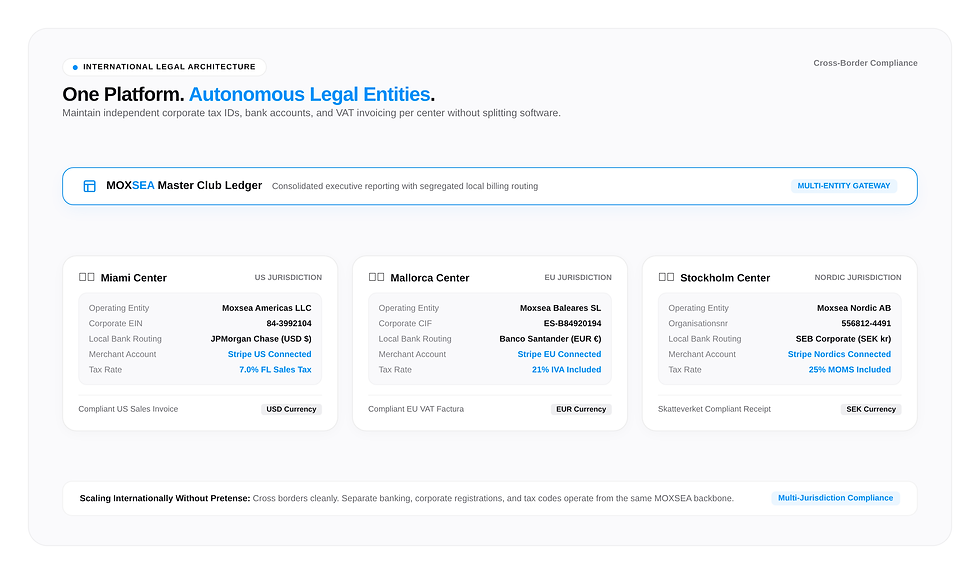
The business can expand without pretending every location is legally or operationally identical.
But Should Every Member Be Able to Book Everywhere?
Here's where multi-location gets interesting.
It would be easy to say:
"With MOXSEA, members can book boats at any location."
But that's not actually how a well-structured boat club should work.
The club decides.
Cross-location access can be configured at the membership level.
A club can decide whether a particular membership tier can access another center at all.
And if that access is available, the club can decide whether it is:
Included as a membership benefit
Available as a paid add-on.

That distinction gives the operator control over the commercial model.
For example, a premium membership might include access to multiple centers, while another membership tier might be able to visit another location only by paying an additional fee.
The important thing is that cross-location access isn't automatically granted simply because the locations exist in the same system.
The club defines the rules.
Your Network Can Grow Without Losing Its Structure
This is where the architecture becomes particularly useful for operators
thinking beyond one or two locations.
Imagine your club eventually has:
Southwest Florida, Mediterranean Coast, Sydney Harbour,
You don't want six completely independent databases.
But you also don't want every location behaving as though it is operating in the exact same market.
MOXSEA gives you the middle ground.
At the network level:
You can oversee the business as one club.
At the center level:
Each location can operate according to its own setup.
That's a much more realistic model for a growing boat club.
Corporate Oversight. Local Control.
The organisational structure inside the platform reflects this distinction.
MOXSEA supports different staff roles based on the level of access they need:
Club Admin
Has visibility and management access across the entire club and its centers.
Center Admin
Manages their specific center.
Center User
Has access limited to their assigned center or centers.
This means you don't have to choose between two extremes:
Give everyone access to everything.
Create completely separate systems.
Instead, access can reflect how the organization actually operates.
Headquarters can oversee the network without taking control away from the people running each location.
See the Whole Business Without Opening Six Dashboards
Central oversight becomes particularly valuable when you're managing multiple locations.
A side-by-side dashboard gives the club visibility across centers, including information such as:
Members
Boats
Revenue
Ratings
Today's bookings
That changes the question from:
"What's happening at Location A?"
to:
"What's happening across the business?"

And once you can see the locations side by side, you can start identifying differences.
Which center is growing fastest?
Where is fleet utilization stronger?
Where are ratings changing?
Which location has more bookings today?
Where might additional fleet capacity be needed?
The system doesn't make the business decisions for you.
It gives you a clearer view of the business you're actually running.
Your Fleet Doesn't Have to Stay in One Place
There is another operational reality that becomes increasingly important as a boat club grows:
Boats move.
A boat that makes sense in one location during the summer may make more sense somewhere else during another season.
A new center may need additional fleet capacity.
A location may temporarily have more demand than another.
MOXSEA allows boats to be reallocated between centers while preserving their history.
That means the fleet can move with the business without losing the operational record attached to the boat.
You aren't starting over every time a boat changes location.
The history stays with the asset.
Your Member Can Travel Too
The same principle applies to members.
A member may have a home center but occasionally visit another location.
When that happens, the system can identify the member as a visiting member on the booking.
That gives local staff important context.
They can see:
Is this member local?
Or are they visiting from another center?
And importantly, the member's home-center billing rules travel with them.

That helps prevent an awkward situation where a member travels to another location and suddenly encounters a completely different pricing assumption simply because they are physically somewhere else.
The network can remain connected while the commercial rules remain controlled.
One Account Can Also Mean More Than One Club
And then there is a different kind of growth.
Not every expansion strategy means opening another center under the same club.
Some operators may eventually operate:
multiple clubs, brands or separate businesses.
MOXSEA supports staff or members who belong to multiple separate clubs being able to switch between them from a single account.
That's a subtle feature, but it becomes increasingly relevant as operators grow beyond a single brand or organization.
Because sometimes the future isn't:
One club → 20 centers.
Sometimes it's:
One operator → multiple clubs.
Your software needs to be able to understand the difference.
The Scaling Problem
Nobody Talks About
When people talk about expanding a boat club, they usually focus on the exciting parts.
More boats.
More members.
More locations.
More revenue.
But every new location also creates another layer of operational complexity.
Every location introduces another set of:
Rules
Staff
Boats
Members
Schedules
Pricing
Maintenance
Billing
Local requirements
Operational decisions
If the software doesn't scale with that complexity, the organization eventually compensates with something else:
More spreadsheets.
More manual processes.
More communication.
More checking.
More people trying to keep everything synchronized.
And that is how operational complexity starts eating into the benefits of growth.
The Goal Isn't to Make Every Location Identical
This is perhaps the most important principle behind multi-location operations:
Standardize what should be standardized. Localize what needs to be local.
Your brand can remain consistent.
Your systems can remain connected.
Your leadership can have centralized visibility.
But your locations don't need to pretend they operate in identical environments.
That's what makes a scalable system different from simply having multiple locations inside the same piece of software.
A scalable system understands that independence and connection can exist at the same time.
One Business. Different Realities.
A boat club with one location has one operational environment.
A boat club with ten locations has ten.
The challenge isn't eliminating those differences.
It's managing them without allowing them to fragment the business.
With MOXSEA, the idea is simple:
One club.
Many centers.
Independent operations.
Shared visibility.
Controlled access.
One connected system.
Because the goal of scaling isn't to make your business more complicated.
It's to make the complexity manageable.
Built for the Boat Club You're
Growing Into
Maybe you're operating one location today.
Maybe you're already managing several.
Maybe your next location is in another city.
Maybe your long-term plan crosses borders.
The operational question is the same:
Can your software grow with you without forcing every location into the same box?
MOXSEA is built around that idea.
Your centers can operate independently.
Your headquarters can maintain visibility.
Your members can access the locations the club chooses to make available.
Your fleet can move between centers while retaining its history.
Your legal entities can remain separate.
And your entire network can still operate from one connected platform.


Comments