
Stop Fighting for Market Share: Start Building the Market with Boat Sharing Clubs
The 44% Problem: Why Boat Sharing Is Becoming the Industry’s Growth Engine
I spent last week at Boot Düsseldorf hearing the same thing: dealers are overstocked, and demand is cooling. But we aren’t facing a lack of interest; we’re facing a refusal to meet the modern consumer where they actually are. Here is why the 44% of people choosing "access over ownership" isn't a threat to your business but your biggest untapped pipeline.
I’ve just returned from Boot Düsseldorf, energised by the scale and ambition of the world’s largest indoor boat show but also genuinely puzzled.
In conversations with several boat manufacturers, a familiar set of concerns kept surfacing: dealers carrying large inventories, significant capital tied up in stock, and margin pressure. Yet throughout these discussions, one question kept coming back to me: Why are so few OEMs viewing boat sharing as a strategic opportunity rather than a threat?

A structural shift in the leisure boat market
Across industries well beyond boating, consumer behaviour is fundamentally changing. Research into the sharing economy shows we’ve hit a tipping point: 44% of modern consumers now prefer "access over ownership".
This isn't just a trend; it's a structural shift in how people consume mobility, travel, and leisure. In practical terms, this means a massive segment of the market is unlikely to ever buy a boat through traditional pathways. They aren't "future owners" waiting to be convinced by a brochure; they are people who value the experience over the asset
Ignoring this segment doesn’t protect the existing business model; it simply shrinks your total addressable market.
Why people actually join boat clubs.
One insight is remarkably consistent across boat club operators: the majority of people who join have zero intention of buying a boat.

Data from major industry players like Freedom Boat Club suggests that up to 92% of members join without any plan to purchase. They aren't comparing a club membership to a boat loan; they are comparing it to not boating at all. They join because boat clubs remove the psychological and practical barriers of the traditional model.
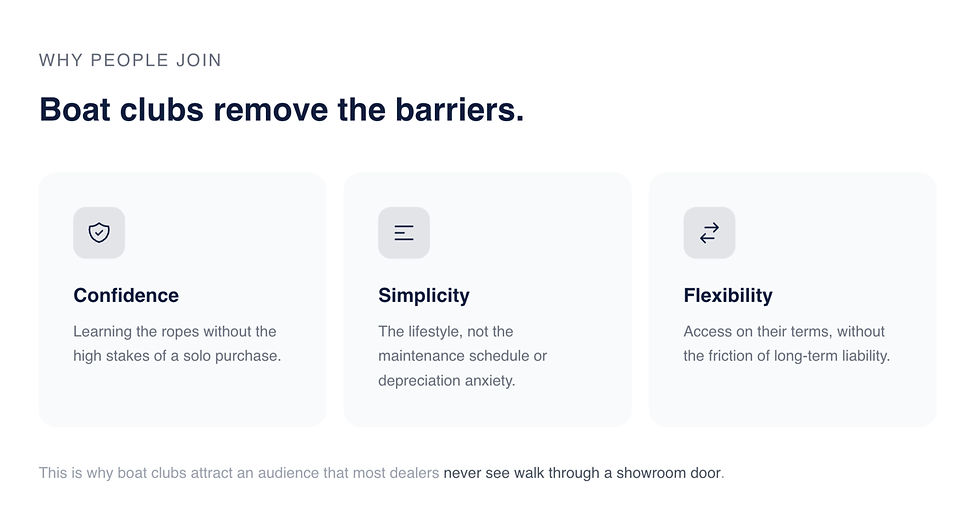
Boat Sharing Clubs Removes the barriers of:
Confidence: Learning the ropes without the high stakes of a solo purchase.
Simplicity: They want the lifestyle, not the maintenance schedule or depreciation anxiety.
Flexibility: Access on their terms, without the "friction" of long-term liability.
This is why boat-sharing clubs attract an audience that most dealers never see walk through a showroom door.
The "Experience Gap" is the real opportunity
Here’s the part that many OEMs overlook: While members don't join to buy, the experience changes their minds. After 1–3 years of active participation building confidence and an emotional connection to the water, roughly 20% of these members go on to purchase a boat.

These are not impulse buyers. They are highly educated, highly qualified, and low-risk; they are moving toward ownership because it finally "fits". Today, many manufacturers are missing 100% of these buyers because they aren't present at the start of the journey.
Boat Sharing Clubs: A pipeline, not competition

At Boot Düsseldorf, the paradox was striking.
I heard:
“Our dealers are overstocked.”
“Demand feels unpredictable.”
Yet, boat clubs are the ultimate "shock absorber" for the industry. They absorb inventory by purchasing in volume, refresh fleets on predictable cycles, and build brand loyalty by introducing customers to specific models through hands-on use.
Rebuilding the on-ramp to ownership
Boat sharing isn’t about replacing ownership; it’s about rebuilding the path toward it. In a world where fewer people are willing to "jump blind" into a six-figure purchase, experience must come first.
The irony? The best-prepared future owners in the industry are currently being "trained" outside the traditional OEM–dealer ecosystem.
The real question isn’t “Why boat sharing?” It’s: Why would any manufacturer choose to miss these buyers entirely?
Boat sharing is no longer a side experiment. It is a strategic bridge and a growth engine that the industry can no longer afford to ignore. References & Data Sources:
To ensure our insights are grounded in market reality, the figures cited in this article are derived from the following industry benchmarks:
The 44% "Access" Metric:Derived from the TIME Magazine / Aspen Institute / Burson-Marsteller Shared Economy Study. This research identifies that 44% of U.S. adults have participated in or prefer access-based sharing economy services (e.g.,Airbnb, Uber, and shared mobility).
The 92% "Non-Buyer" Intent: Based on investor relations data from Brunswick Corporation (Freedom Boat Club). It tracks the percentage of new club members who report having no active intention to purchase a vessel at the time of joining.
The 20% Conversion Rate: This is the industry-standard "Member-to-Owner" pipeline metric reported by major global boatclub networks, typically occurring within a 24-to-36-month membership window


Comments